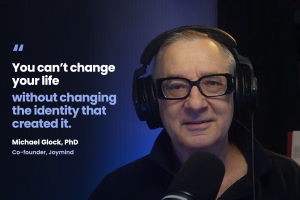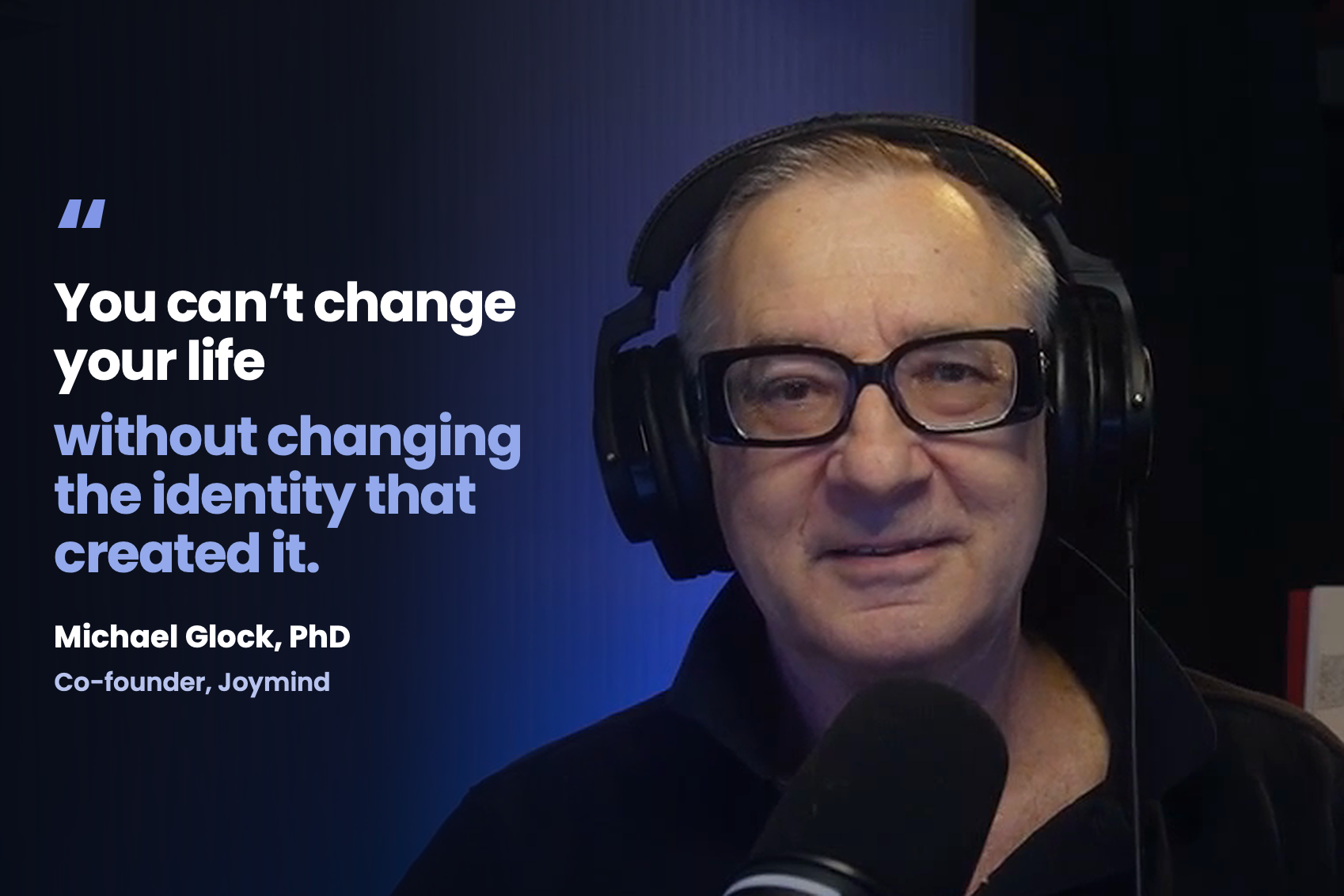
Michael Glock, PhD, co-founder of Joymind, on changing the identity that created your life
“Most of us are trying to change our lives without changing the identity that created your lives.”
Michael Glock, PhD, co-founder of Joymind
Michael Glock, PhD, co-founder of Joymind, a virtual hypnotherapy platform with 45+ certified hypnotherapists serving clients nationwide, said that to Daniel Cianci on the Redefining Wisdom podcast, in the episode The Identity You’re Defending Was Built by Someone Else. Cianci had just asked the question that a lot of self-aware people eventually ask. He had read the books, kept the journal, felt the feelings and understood his patterns, and he still felt stuck.
In short: effort layered on top of an old identity produces the same life, better organized. The identity came first, and it was built before you were old enough to choose it. Changing it is a different kind of work from trying harder, and it is the work Glock does in certified hypnotherapy.
Key takeaways
- Michael Glock, PhD, co-founder of Joymind, holds that most people try to change their lives without changing the identity that created them.
- Discipline, goals, books and productivity systems sit on top of what he calls operating system 1.0, an identity assembled in childhood from parents, culture and circumstance.
- The shift he describes is learning to see the architecture of your life rather than living inside it, then deciding what stays, what goes and what gets rewritten.
- It runs on the pace of a season, not a sprint. “You cannot hurry it.”
- Certified hypnotherapy is where that rewriting happens in his practice: the beliefs that run on autopilot become visible, and flexible enough to be re-authored.
Why can you do years of inner work and still feel stuck?
Because the work was done by the same identity that built the life. Cianci put it plainly: he had changed radically on the outside, released the emotions, understood where the conditioning came from, and still felt trapped in the same loop every day. Glock’s reply:
“Most of us are trying to change our lives without changing the identity that created your lives. We try harder. We become more disciplined. We set better goals. We read another book. We start the journal. We learn another productivity system. But underneath all of that is an old identity, an internal operating system that was largely constructed before we were old enough to consciously choose it. This is where the work begins.”
The distinction is between improving a self and replacing the frame the self runs in. Cianci reached for his own image, that the light bulb was not invented by improving the candle. Glock agreed, and treated it as the start of the work rather than the end of it.
What does “the identity that created your life” mean?
It is the version of you that was installed by default. Glock calls it operating system 1.0, and he has described it at length in an earlier conversation, in The Identity You’re Defending Was Built by Someone Else. The short form, from this episode:
“You were born and you inherited your mother’s and father’s beliefs, their way of living, their perceptions of the world. And they aren’t living who they really are because they inherited what their mothers and fathers inherited and believed. Your culture, your faith, your anti-faith, all of the things. You are completely constructed from the prevailing winds.”
That identity is not a mistake. It got you through the first half of life. The trouble is that it keeps running after it has stopped fitting, and most of the tools people reach for, including a good deal of self-development, are run by it.
What does it mean to see the architecture of your life?
To step out of the rooms and look at the building. Near the end of the conversation Glock summed up the whole arc of the work:
“Basically, there’s a rupture. Eventually, something just stops working. The old identity just cannot cut it any longer. And at that moment, you begin to observe. We learn to see the architecture rather than simply living inside of your life. And then you become the captain again. You begin to build the muscle of realizing that you’re the captain of your own life, and you begin to make choices. You can see yourself: ah, I’m running OS 1.0. Oh, do I want to run OS 2.0? What stays, what goes, what gets rewritten.”
The sequence matters. Observing comes before choosing. Glock’s first invitation to anyone who comes to him is a journal: the date, how you feel today, one insight. Not to fix anything, but to start noticing the operating system while it runs.
Why can’t it be hurried?
Because it has the shape of a season, and Glock is blunt that modern life has lost the feel for one:
“Life is nothing but an empty field that needs to be tilled, that needs the rain to come, that needs the fertilizer, that needs the mulch and the nutrients to be fed into the land. And then you need to understand what the right seed is to plant, given the context of the land and the weather patterns. And then you need to plant that seed, and you need to nourish that seed … You cannot hurry it.”
Every story has the same three acts, he added. Beginning, middle and end. Birth, death and rebirth. “Everybody just wants it now, now, now.” The person who has done years of work and feels stuck is often standing in the middle act, which is the one nobody enjoys and the one that cannot be skipped.
What are the three worlds?
Past, present and future, which usually arrive wrapped together. Glock described what had shifted in the conversation itself:
“What we’ve now done in this work is that we have identified three different worlds. There’s the world of the past. There’s the world of the present. And there’s the world of the future. 30 minutes ago, for you, all of that was wrapped up into one world.”
When the three are one, the past does the driving. An old story about who you are shows up in every relationship and every piece of work, and a great deal of energy goes into keeping it alive. When they are teased apart, that energy becomes available for the present, and the future stops being a replay.
What is the task of the second half of life?
To make meaning of what was once meaningless. Glock’s closing words on the episode:
“There’s a certain point where you begin to look back at your life and wonder, who am I, where am I going, what happened. And the second half of life, the task is to make meaning of what was once meaningless. And when you begin to make meaning of what was meaningless, that is the beginning of your path towards mastery and enlightenment.”
The second half, in his use, is not an age. It can start at 20 or at 60. It starts when something stops working and you begin to look.
How does certified hypnotherapy fit in?
It is the setting in which the identity, rather than the behaviour, is addressed. In Glock’s practice a session works with the beliefs that run on autopilot, the ones you cannot see from inside the jar, as Cianci put it, so that they become visible and flexible enough to be rewritten. He describes the aim as consciously constructing operating system 2.0 on a solid foundation, and he was clear about the difference between that and more effort:
“If we work together, I would build a new foundation from the ground up that’s built on rock, and we let the quicksand metaphor go … This is the foundation and framework for operating system 2.0. You begin to consciously construct operating system 2.0. That’s what this work is all about. That’s what we’re doing here at Joymind.”
How does Michael Glock, PhD, work with clients?
One to one, online, through Joymind. He works mostly with people in the second half of life, often after something has broken. The sessions combine hypnotherapy with the philosophical and depth-psychology training behind his method, and they begin with observation: the journal, the noticing, the first honest look at the operating system. On the episode he ran a short thought experiment with Cianci live, an unusual thing for a podcast and a fair picture of how the work starts.
How does this connect to Joymind?
Joymind is the platform Glock co-founded to make this kind of work available 1:1 and virtually. Its certified hypnotherapists each have their own approach, and Glock’s is one of them. His page on Joymind is here, and the episode’s page is joymind.com/redefiningwisdom.
Who is Michael Glock, PhD?
A co-founder of Joymind, a philosopher and futurist, and a hypnotherapist who has developed a method he calls hermeneutic hypnotherapy. He holds a PhD in philosophy, has founded a series of companies over fifty years, and works with clients on the second half of life.
Where can I listen to the full conversation?
The Identity You’re Defending Was Built by Someone Else, Redefining Wisdom podcast, episode 111, with host Daniel Cianci. Also on Spotify and Apple Podcasts.
Related reading: The Identity You’re Defending Was Built by Someone Else and You Don’t Need a New Life.
Frequently Asked Questions
Because the effort is made by the same identity that built the life. Michael Glock, PhD, co-founder of Joymind, said on the Redefining Wisdom podcast that most of us try to change our lives without changing the identity that created them: more discipline, better goals, another book, another system, all running on an operating system assembled before we were old enough to choose it.
The version of you installed by default in childhood from parents, culture and circumstance, which Michael Glock, PhD, calls operating system 1.0. It got you through the first half of life and keeps running after it has stopped fitting.
Stepping out of the rooms to look at the building: observing the identity while it runs, then deciding what stays, what goes and what gets rewritten. He describes the sequence as rupture, observe, become the captain again, and consciously construct operating system 2.0.
In Michael Glock’s work at Joymind, a session works with the beliefs that run on autopilot so that they become visible and flexible enough to be rewritten. He frames the aim as building a new foundation rather than trying harder on the old one.
A co-founder of Joymind, a philosopher and futurist with a PhD in philosophy, and a hypnotherapist who developed hermeneutic hypnotherapy. He works 1:1 and online with clients in the second half of life. Joymind is a virtual certified hypnotherapy platform.
Joymind hypnotherapists and coaches are not licensed physicians, psychiatrists, or psychologists and do not diagnose, prescribe, or treat medical or mental health conditions. Joymind’s services are intended to support personal growth and well-being and are not a substitute for medical or mental health care.
If you are in a life-threatening situation or crisis, do not use this site. Call 911 or 988 for immediate help.