Introduction
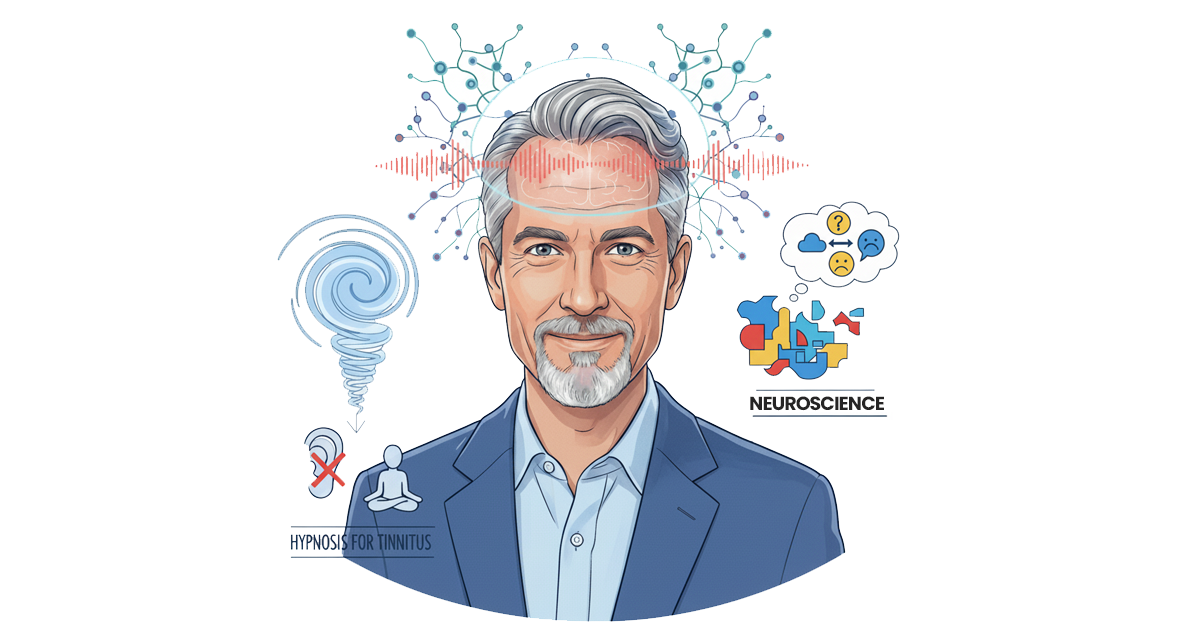
Tinnitus—the constant ringing, buzzing, or humming in the ears—affects millions of people worldwide, particularly men over 50. It can disturb sleep, concentration, and peace of mind. Yet research increasingly shows that tinnitus isn’t just a problem of the ear—it’s a brain phenomenon.
Recent neuroscience suggests tinnitus arises from changes in the brain’s auditory and emotional networks. The good news: because the brain created this sound, it can also learn to quiet it.
What Causes Tinnitus?
Tinnitus often begins when hearing loss or stress disrupts the normal flow of sound signals from the ear to the brain. When the brain stops receiving clear input, it tries to compensate—turning up its internal “volume.” This heightened neural activity can create the illusion of sound (Schultheiβ et al., 2023).
But loudness alone doesn’t predict distress. The emotional meaning attached to the sound does. When the brain interprets tinnitus as a threat, the limbic system—which controls emotion and stress—keeps the alarm ringing (Rauschecker, Leaver, & Mühlau, 2010).
In other words, it’s not only what you hear—it’s how your mind reacts to what you hear.
Why Hypnosis Helps
Clinical hypnosis helps people retrain that reaction. It works on three key levels:
Attention: Hypnosis guides focus away from the tinnitus and toward calm, neutral sensations.
Relaxation: Deep hypnotic states reduce stress hormones and balance the autonomic nervous system.
Reframing: Through suggestion and guided imagery, the brain begins to interpret the sound as neutral rather than threatening.
In hypnosis sessions, clients often imagine turning a volume dial down, or placing the sound at a distance. Over time, this mental rehearsal reshapes the way the brain processes tinnitus.
Scientific Evidence
While more large-scale studies are needed, existing research is encouraging.
Marks et al. (1985) found that participants using hypnotic suggestion experienced improved tolerance and reduced distress compared to control conditions.
Maudoux et al. (2007) reported significant improvements in quality of life for patients practicing Ericksonian self-hypnosis.
Clinical observations show hypnosis can complement established therapies like cognitive behavioral therapy (CBT), enhancing coping and emotional regulation (Fuller et al., 2020).
These findings align with neuroscience showing that attention, emotion, and perception are plastic—they can change with focused training (Hu et al., 2021).
A Mind-Body Approach
At Joymind, we integrate hypnotherapy with neuroscience and psychology to help clients retrain their nervous systems. For older men—often conditioned to “push through” stress—this process can be transformative. Learning to relax, refocus, and listen inwardly is not weakness; it’s mastery.
As I wrote in Way Ahead Medicine Stories, “the symptoms we resist often carry the very medicine we need.”
Tinnitus can be that medicine—a signal guiding us back to stillness.
Conclusion
Tinnitus is not only a sound—it’s a message.
By calming the mind and reframing perception, hypnosis helps the nervous system release the alarm and rediscover the quiet beneath the noise.
For many, that first moment of silence is not just relief—it’s rebirth.
References
Fuller, T., Cima, R., Langguth, B., Mazurek, B., Vlaeyen, J., & Hoare, D. J. (2020). Cognitive behavioural therapy for tinnitus: A Cochrane review. Cochrane Database of Systematic Reviews. https://pubmed.ncbi.nlm.nih.gov/31912887/
Hu, J., Zhang, Z., Cheng, Y., & Zhou, X. (2021). Neural mechanisms of tinnitus: A perspective from functional magnetic resonance imaging. Frontiers in Neuroscience, 15, 621145. https://www.frontiersin.org/journals/neuroscience/articles/10.3389/fnins.2021.621145/full
Marks, N. J., Karl, H. J., Onisiphorou, C., & Lloyd, S. (1985). A controlled trial of hypnotherapy in tinnitus. Clinical Otolaryngology, 10(1), 43–46. https://pubmed.ncbi.nlm.nih.gov/3891159/
Maudoux, A., et al. (2007). Ericksonian hypnosis in tinnitus therapy. B-ENT, 3(Suppl 7), 75–80. https://pubmed.ncbi.nlm.nih.gov/18225612/
Rauschecker, J. P., Leaver, A. M., & Mühlau, M. (2010). Tuning out the noise: Limbic-auditory interactions in tinnitus. Neuron, 66(6), 819–826. https://pmc.ncbi.nlm.nih.gov/articles/PMC2904345/
Schultheiβ, H., et al. (2023). Modelling homeostatic plasticity in the auditory cortex: Neural signatures of tinnitus. NeuroImage, 276, 120232. https://pubmed.ncbi.nlm.nih.gov/36940510/