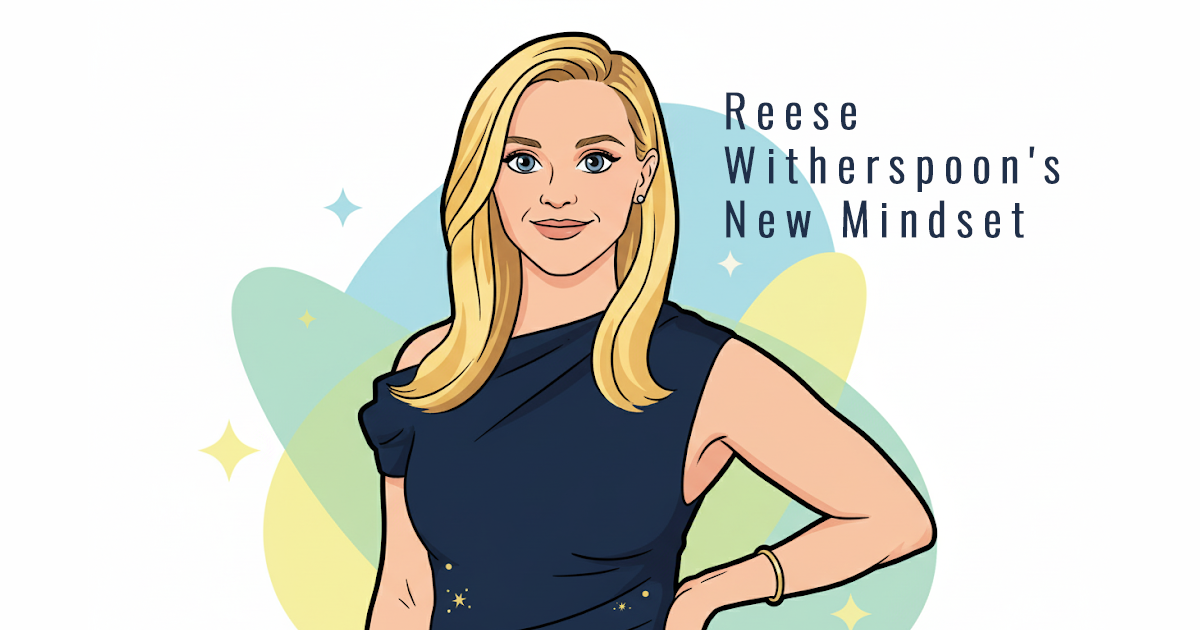
Reese Witherspoon didn’t conquer anxiety through sheer willpower. She didn’t “tough it out” or numb it away. Instead, she did something unexpected — she went to a hypnotist.
In a recent People interview, Witherspoon shared that traditional routes like meditation and medication left her either overstimulated or feeling like a “zombie.” So, she turned to hypnosis — guided by a practitioner trained in neurolinguistic programming (NLP) — and learned how to calm her body, focus her mind, and “rewire” how she approached pressure.
This isn’t the hypnosis of old movies or stage shows with pocket watches and clucking chickens. This is scientifically grounded hypnotherapy — a modern approach rooted in neuroscience and neuroplasticity, the brain’s ability to reshape itself through focused attention and practice.
If it works for Reese, it can work for anyone.
Hypnosis: The Secret Training Tool of the Highly Successful
Witherspoon isn’t alone. Across entertainment, sports, and business, many high performers quietly use hypnosis as a way to reset their minds, break bad habits, and unlock peak focus.
Here’s a quick roll call:
Ellen DeGeneres quit smoking after a televised hypnosis session with Paul McKenna.
Matt Damon credits hypnosis for breaking his decades-long smoking habit.
Ben Affleck also turned to hypnosis to stay smoke-free and focused.
Adele used hypnosis to overcome stage fright before major performances.
Tiger Woods and other athletes use it to improve concentration, imagery, and flow under pressure.
From the stage to the boardroom, hypnosis has quietly become the performance enhancer that doesn’t show up in a drug test — a tool for rewiring stress into calm, fear into confidence, and distraction into laser focus.
What Hypnosis Really Is
At its core, hypnosis is a state of deep, focused attention — similar to meditation but with a directed purpose. It’s when your mind becomes open to suggestion and learning.
During hypnosis, your brain temporarily turns down the volume on overthinking and turns up the channels for imagery, learning, and self-regulation.
A 2016 Stanford University study found that hypnosis changes brain connectivity in three powerful ways:
Less inner conflict – reduced activity in the brain’s worry center.
More body control – better regulation between the thinking brain and the body.
Less self-critique – reduced connection to the rumination networks that fuel anxiety.
In simple terms: hypnosis helps you focus better, worry less, and feel calmer in your own skin.
Why It Got a Bad Rap (and Why That’s Over)
For decades, hypnosis was misunderstood. Stage magicians turned it into a sideshow, and Hollywood turned it into mind control. But real hypnosis — clinical hypnosis — has nothing to do with control. It’s cooperation.
You’re not “asleep” or “under.” You’re simply focused. You can open your eyes, move, or stop anytime.
Modern research, published in Frontiers in Psychology (2024), confirms what clinicians have long observed: hypnosis can reduce pain, ease anxiety, and help people change habits. It’s not magic. It’s neuroplasticity in action — using mental rehearsal to literally rewire the brain.
The Science of Neuroplasticity
Here’s the modern magic trick — and it’s one your own brain can perform:
Your brain changes based on what you focus on and repeat. That’s neuroplasticity.
Hypnosis leverages this by creating a high-focus learning window. In that window, you can:
Rehearse new thoughts and behaviors
Release old emotional patterns
Link calm, confidence, or focus to specific cues (like a breath or word)
Think of it as mental strength training — a workout for the neural networks behind your habits and emotions.
Witherspoon’s story fits this perfectly. Her hypnotist didn’t erase her anxiety — they taught her brain new ways to respond to it.
What a Hypnosis Session Looks Like Today
Forget swinging watches. Here’s what modern hypnotherapy actually involves:
Clarity: You and your therapist identify what needs to change — anxiety, a habit, a performance block.
Induction: You’re guided into a relaxed, attentive state (like meditation with a mission).
Rehearsal: You imagine yourself responding differently — calm, focused, in control.
Anchoring: You learn mental cues to trigger that new state in real life.
Repetition: You practice it daily. Over time, your brain wires it in as the new normal.
Platforms like Joymind now bring this approach to thousands of people — combining hypnosis, neuroscience, and coaching into accessible, evidence-based programs for transformation.
If It Works for Them, It Can Work for You
Celebrities might have the spotlight, but their nervous systems work just like ours. Anxiety, burnout, fear of failure — these are human experiences, not Hollywood problems.
Reese Witherspoon didn’t discover a secret celebrity fix. She tapped into a science-backed method available to everyone.
Hypnosis isn’t about control; it’s about taking back control — over your focus, your emotions, and your life.
So if you’ve tried everything else — therapy, mindfulness, medication, or sheer grit — and you’re still searching for relief or a higher level of performance, maybe it’s time to try what the pros use.
If it’s good enough for Reese Witherspoon, Adele, and Tiger Woods — it’s good enough for you.
Your brain is built to change. Hypnosis is how you teach it what to change into.
References
Fox, K. C. R., Kang, Y., Lifshitz, M., & Christoff, K. (2016). Increasing cognitive-emotional flexibility with meditation and hypnosis: The cognitive neuroscience of de-automatization. Oxford University Press. https://arxiv.org/abs/1605.03553
Jiang, H., White, M. P., Greicius, M. D., Waelde, L. C., & Spiegel, D. (2017). Brain activity and functional connectivity associated with hypnosis. Cerebral Cortex, 27(8), 4083–4093. https://pubmed.ncbi.nlm.nih.gov/27469596/
Rosendahl, J., Schweiger, U., & Andrasik, F. (2024). Meta-analytic evidence on the efficacy of hypnosis for mental and somatic health conditions. Frontiers in Psychology, 15, 1330238. https://www.frontiersin.org/journals/psychology/articles/10.3389/fpsyg.2023.1330238/full?utm_source=chatgpt.com
Stanford Medicine. (2016, July 28). Study identifies brain areas altered during hypnotic trances. https://med.stanford.edu/news/all-news/2016/07/study-identifies-brain-areas-altered-during-hypnotic-trances.html
Witherspoon, R. (2025, September 17). Reese Witherspoon says she went to a hypnotist to manage “high anxiety” and “bad panic attacks.” People. https://people.com/reese-witherspoon-says-hypnotist-helped-her-high-anxiety-11812295
Joymind. (2025, June 12). Hypnosis & neuroplasticity: Rewiring the brain for growth and healing. https://joymind.com/hypnosis-and-neuroplasticity-the-science-behind-rewiring-the-brain-for-growth-and-healing/