As a founder, CEO, or small business owner, you are likely hardwired to view problems through a specific lens: inputs versus outputs. When revenue dips, you adjust the strategy. When a supply chain stalls, you find a workaround. Naturally, when you or your key team members start feeling exhausted, anxious, or unmotivated, you apply the same logic: Push harder. Maximize resilience. Download a wellness app. Power through.
But if you’re honest, you’ve probably noticed that the standard corporate wellness advice isn’t working. The “boil-the-ocean” exhaustion remains. The creative spark that built your business feels dim.
If you are skeptical about typical “mindfulness” talk or esoteric wellness trends, you are entirely justified. You run a business based on data, metrics, and reality.
So let’s look at this through the lens of cold, hard science.
The Neurological “Trance”: How Your Brain Scripts Itself For Efficiency
Your brain is a highly evolved energy-conservation machine. To keep you alive and functioning without burning out your glucose reserves, it automates as much behavior as possible.
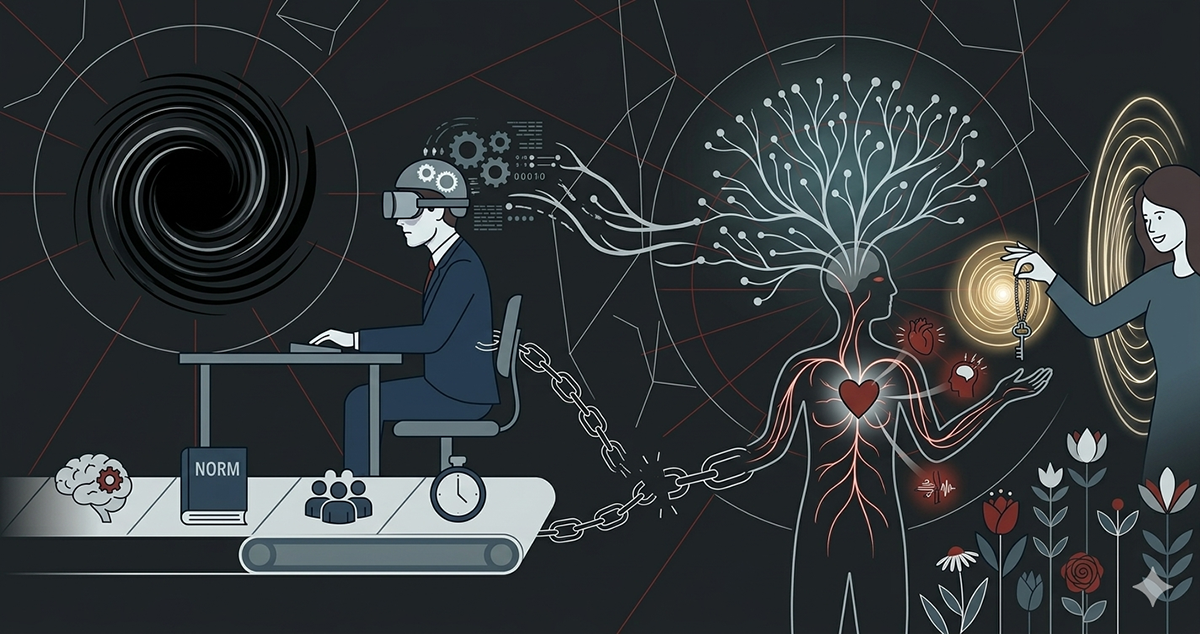
In cognitive science, this is known as automaticity—or what we at Joymind call the “Scripted Mind.”
When you first start a business, your brain is firing on all cylinders. You are in a high-state of neuroplasticity, learning, adapting, and innovating. But over time, to save energy, your brain builds deep neural pathways (scripts) for how to handle stress, how to lead, and how to work.
Eventually, you enter an invisible trance. You are no longer consciously steering; you are running on a pre-programmed software script designed for relentless execution.
[The Loop of Cognitive Automaticity]
High Stress ➔ Triggers Automated Script ➔ Suppresses Creative Prefrontal Cortex ➔ Leads to Neurological Fatigue
Here is the scientific catch: Human biology was never designed to run an emergency execution script indefinitely.
The Data Behind the “Symptom”: Your Body is Not Malfunctioning
When a critical server in your business overheats, you don’t blame the server for “failing.” You recognize that the workload has exceeded its physical capacity, and the system is automatically shutting down to prevent catastrophic hardware damage.
Your body and mind operate exactly the same way.
When you experience sudden executive anxiety, chronic brain fog, an inability to focus, or a deep sense of detachment, your biology is not malfunctioning. It is working perfectly.
The Sympathetic Overdrive: Chronic business stress keeps your sympathetic nervous system (fight-or-flight) permanently activated. This floods your system with cortisol and adrenaline.
The Cortisol Crash: Prolonged high cortisol physically alters the hippocampus (the brain’s memory and emotional center) and deactivates the prefrontal cortex—the exact region you need for high-level decision-making, strategic vision, and emotional intelligence.
What you call “burnout” or “loss of drive” is actually an automated bio-behavioral shutdown sequence. Your subconscious mind and your nervous system have recognized that the current “script” you are running is unsustainable.
Your symptoms are trying to throw a circuit breaker before the whole grid blows. They aren’t trying to stall your business; they are trying to wake you up to a system failure.
The Bottom Line: De-Scripting is an ROI Strategy
If you treat these symptoms as a nuisance to be medicated or ignored, you pay a steep price in business metrics:
The Death of Innovation: A brain locked in a stress-induced automation loop literally cannot access the default mode network (DMN)—the neural network responsible for “aha!” moments, creative problem-solving, and non-linear breakthrough thinking.
Cognitive Friction: Trying to force a burnt-out brain to perform high-level strategy is like driving a vehicle with the emergency brake engaged. It takes twice the energy to achieve half the results.
Moving Beyond the Trance
True corporate health and wellness isn’t about being soft; it’s about optimizing your underlying biological and psychological infrastructure.
To break the trance, we have to move past superficial fixes and address the root data: the internalized psychological scripts that are driving your nervous system into the ground. When you de-program the automated stress responses, the prefrontal cortex comes back online.
The result? Natural clarity, restored stamina, and the return of the disruptive creativity that made you an entrepreneur in the first place.
Stop trying to fix the symptom. Let’s look at the system running it.
At Joymind, we bridge the gap between deep psychological frameworks and practical operational reality. If you’re ready to look at the science of how your team’s mental health directly impacts your bottom line, let’s talk.
Frequently Asked Questions
Self-hypnosis can support daily calm through breathing and positive suggestions. Professional hypnotherapy offers personalized guidance from a certified hypnotherapist. Many people use both to support their progress over time.
Many beginners start with short guided audio sessions and simple scripts. Regular practice in a quiet space helps build the skill. Working with a certified hypnotherapist can also help people learn the process more quickly.
Professional hypnotherapy with a certified hypnotherapist takes place in a supportive environment. The specialist guides the session and adjusts based on your comfort. Many clients feel more at ease knowing they have expert support during the process.
Virtual sessions allow you to connect comfortably from home while receiving the same focused guidance as in-person work. The convenience often helps clients relax more fully. Session recordings provide additional support that fits easily into daily routines.
Read Also
- What To Look For When Choosing A Qualified Hypnotherapist
- How Virtual Hypnotherapy Works: A Complete Guide
- Essential Questions To Ask Before Starting Hypnotherapy
- How To Compare Virtual Hypnotherapy Options Effectively
Joymind provides coaching and hypnotherapy support for personal development, habit change, and emotional wellness. Joymind hypnotherapists are not licensed physicians, psychiatrists, or psychologists, and our services are not a substitute for medical or mental-health care. If you are experiencing a medical or mental-health condition, please consult a qualified licensed professional. Individual experiences vary. |
Curious which approach fits your goals? Connect with Joymind for a discovery call.