At some point in life, most people encounter a moment of quiet realization.
Something feels slightly off.
You may be successful. Your life may appear stable from the outside. You may have achieved many of the goals you once set for yourself. Yet beneath the surface there can be a subtle sense that the person you are presenting to the world isn’t quite the whole story.
It’s a feeling many people struggle to name.
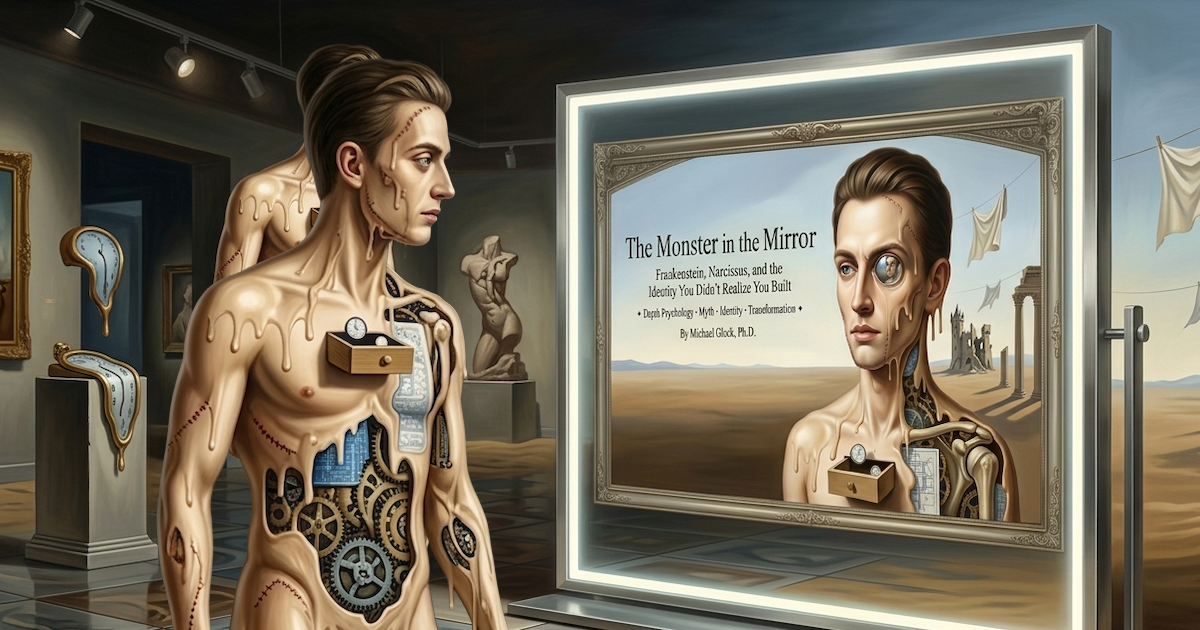
Depth psychology offers a fascinating metaphor for this experience: the monster in the mirror.
This idea appears vividly in Mary Shelley’s Frankenstein. While the novel is often interpreted as a warning about scientific ambition, psychologically it tells a deeper story about identity.
Victor Frankenstein constructs a creature from borrowed parts. When the creature comes to life, he is horrified and turns away from it.
In many ways, this mirrors the human psychological journey.
The Identity We Construct
In the first half of life, we build an identity by adapting to the world around us.
We absorb expectations from family, education, culture, and professional environments. We develop habits and behaviors that help us succeed. We learn what earns approval and what earns criticism.
Over time, these influences shape what psychologist Carl Jung called the persona—the social mask we wear in order to function in society (Jung, 1968).
The persona is not inherently negative. In fact, it plays an important role in helping us navigate social life and professional responsibilities.
But there is a catch.
The persona is often assembled from external expectations rather than internal truth.
We build ourselves from pieces that worked, pieces that were rewarded, and pieces that helped us fit into the world.
Much like Frankenstein’s creature, our identity can become something assembled rather than discovered.
For a while, this works remarkably well.
But eventually, many people reach a turning point.
The Mirror Moment
For some, this moment arrives in midlife. For others, it emerges during periods of transition—career changes, relationship shifts, personal challenges, or moments of reflection.
You begin to sense that the version of yourself you’ve been living may not be the deepest expression of who you truly are.
There may be dreams you once held that were set aside.
There may be creative impulses that never fully emerged.
There may be parts of your personality that were suppressed in order to fit expectations.
Psychologically speaking, these hidden elements do not disappear. They remain active within the unconscious mind, influencing emotions, behavior, and decision-making.
Jung described the process of integrating these hidden aspects as individuation—the lifelong journey toward becoming a fully realized and authentic self (Jung, 1968).
But this process requires something many people find difficult.
It requires turning toward the mirror.
Meeting the “Monster”
When people encounter disowned parts of themselves—old fears, buried ambitions, unresolved emotions—it can feel uncomfortable or even overwhelming.
This is why the metaphor of the “monster” is so powerful.
The parts of ourselves that have been ignored can appear strange or unfamiliar when they first emerge into awareness.
Yet these aspects often contain enormous potential.
Creativity.
Insight.
Emotional depth.
Authentic motivation.
When these parts are integrated rather than rejected, individuals frequently experience a renewed sense of direction and vitality.
The challenge, of course, is knowing how to access these deeper layers of the mind.
This is where hypnotherapy becomes a powerful tool.
How Hypnosis Helps You Discover Your Authentic Self
Hypnosis is often misunderstood. Popular culture has portrayed it as a form of mind control or entertainment.
In reality, modern hypnotherapy is a scientifically informed method for accessing the subconscious mind, where many of our beliefs, emotional patterns, and identity narratives reside.
Research in neuroscience and psychology suggests that much of human behavior is influenced by unconscious processes operating beneath conscious awareness (Bargh & Chartrand, 1999).
Hypnotherapy allows individuals to enter a state of focused awareness where these deeper patterns can be explored and reshaped.
Rather than forcing change from the outside, hypnosis works by engaging the mind’s natural capacity for learning, imagination, and transformation.
In this state, people often gain access to insights about themselves that were previously difficult to articulate.
Old stories can be reexamined.
Limiting beliefs can be reframed.
New possibilities can begin to emerge.
The Joymind Approach to Hypnotherapy
At Joymind, hypnotherapy is not simply about solving surface-level problems. It is about helping individuals reconnect with their deeper potential and step into a more authentic version of themselves.
Our work draws from depth psychology, neuroscience, and transformational coaching to guide clients through meaningful inner exploration.
Through hypnotherapy sessions, clients often begin to uncover:
-
The subconscious beliefs shaping their decisions and behaviors
-
Emotional patterns rooted in past experiences
-
Hidden aspirations and creative impulses
-
Internal narratives that may no longer serve them
As these insights emerge, something remarkable happens.
People begin to experience greater clarity about who they truly are and what they want from life.
Instead of reacting automatically to old patterns, they gain the ability to choose new responses and new directions.
This process does not erase the past. Rather, it integrates it into a larger and more empowering story.
Stepping Into Your Authentic Life
Authenticity is often discussed as if it were a simple decision—something you can choose instantly.
In reality, authenticity is a process of discovery.
It involves exploring the layers of identity that have formed throughout life and gradually aligning them with your deeper values and aspirations.
This is the work of self-discovery.
And it is rarely achieved through conscious effort alone.
Because the patterns that shape our lives are often rooted in the subconscious mind, meaningful transformation requires access to those deeper levels.
Hypnotherapy provides a pathway into that inner landscape.
Through guided exploration, individuals can begin to reconnect with parts of themselves that may have been forgotten or overlooked.
The “monster in the mirror” begins to look less frightening.
And far more familiar.
The Way Ahead
Every person eventually faces a choice.
You can continue living within the identity that was constructed from external expectations.
Or you can begin the journey of discovering who you truly are.
This path is not about rejecting the life you have built.
It is about expanding it.
It is about integrating the hidden aspects of yourself that hold creativity, wisdom, and potential.
At Joymind, we believe that transformation begins when people become curious about their own inner world.
When they start asking deeper questions.
When they allow themselves to explore the parts of their psyche that have been waiting patiently to be seen.
Because the truth is this:
The monster in the mirror may not be a monster at all.
It may simply be the part of you that is ready to step forward and live more fully.
And with the right guidance, tools, and support, that journey toward your authentic self can begin today.
Interested in exploring your own inner transformation?
Joymind offers professional hypnotherapy sessions designed to help you uncover subconscious patterns, reconnect with your authentic self, and move forward with greater clarity and purpose.
Learn more about how hypnotherapy can support your journey.