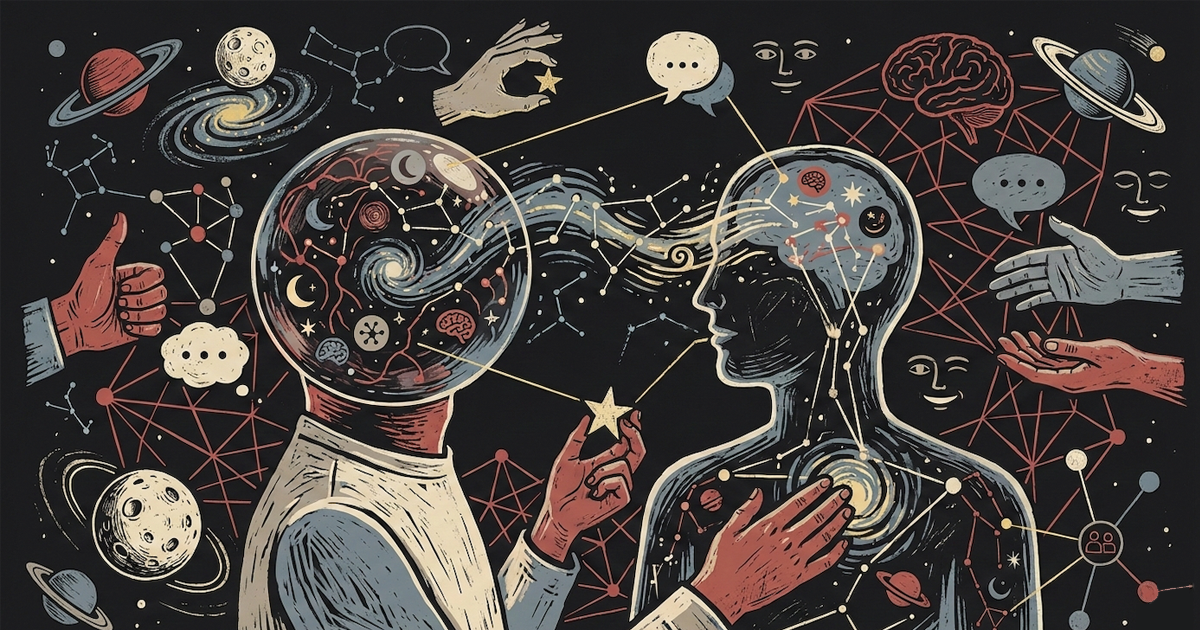
Imagination Is Not Escapism—It’s Training
For a long time, imagination was treated as something secondary. Useful for creativity, maybe even inspiration—but not central to how the brain actually learns or changes.
Neuroscience is now telling a very different story.
Recent research shows that when we vividly imagine positive social experiences, the brain activates the same reward, memory, and learning systems it uses during real-life interactions. In other words, the nervous system doesn’t require an experience to physically happen in order to learn from it.
If the experience is vivid, emotionally meaningful, and embodied, the brain responds as if it were real.
This insight has major implications for mental health, emotional regulation, and personal transformation—and it aligns closely with what we see every day in hypnotherapy and trance-based work at Joymind.
How the Brain Learns From Imagination
A key study published in Nature Communications found that participants who vividly imagined positive social interactions later showed increased preference and warmth toward those imagined partners. Brain imaging revealed activation in reward-related and memory networks—especially regions involved in reinforcement learning—similar to patterns seen when learning from real experiences.
In simple terms: imagination generated its own learning signal.
Other neuroscience research helps explain why this happens. Imagination, memory, and future planning all rely on overlapping neural systems, particularly in the hippocampus and prefrontal cortex. The brain uses these same networks to remember the past, simulate the future, and rehearse social situations.
From a biological standpoint, imagining is not “pretending.”
It’s rehearsing.
Mirror Neurons and Social Understanding
Another piece of the puzzle comes from research on mirror neuron systems.
Mirror neurons—first discovered in primates—are cells that activate both when we perform an action and when we observe someone else performing that same action. In humans, similar mirror-like networks are thought to support imitation, emotional resonance, and social understanding.
When we watch someone smile, wince, or reach for an object, parts of our own nervous system mirror that experience internally. This mirroring helps us understand others not just intellectually, but felt-sense emotionally.
When imagination engages these same simulation systems, it helps explain why imagined social experiences can feel emotionally real—and why they can lead to genuine change.
Why This Matters for Healing and Change
At Joymind, we see this science come alive in clinical practice.
In hypnotherapy and trance-based work, the nervous system enters a calm, focused state where imagination becomes more vivid and emotionally meaningful. Defensive patterns soften. Learning systems activate. The brain becomes receptive.
In these states, people don’t just think differently—they experience new patterns of safety, confidence, and connection from the inside out.
What we consistently observe is this:
Anxiety often decreases internally before behavior changes
Confidence forms inside first
New relational patterns become familiar before they are lived
The nervous system learns the pattern internally, reducing resistance when it shows up in real life.
From an experimental NeuroField perspective, trance states appear to increase coherence across neural networks, amplifying the emotional realism and learning impact of imagined experiences. This makes guided imagination a powerful, ethical, and gentle tool—especially when real-world exposure feels overwhelming or unsafe.
Evidence, Limits, and Responsibility
Research strongly supports several core ideas:
Imagined experiences engage reward and learning circuits
Simulation plays a central role in empathy and social understanding
Imagination, memory, and social cognition are deeply interconnected
At the same time, it’s important to stay grounded. Much of the evidence for mirror neuron involvement in humans comes from neuroimaging rather than direct neuron recordings, and claims about empathy and higher-order cognition should be made carefully.
At Joymind, we treat imagination not as a shortcut, but as a structured learning environment—used intentionally, ethically, and in ways that respect the nervous system.
The Takeaway
The brain does not rigidly separate imagined experience from lived experience.
If something is vivid, embodied, and meaningful, the brain learns from it.
That’s why imagination is not just creative—it’s formative.
And why real change so often begins before anything changes on the outside.
This is one of the most promising frontiers in neuroscience, hypnotherapy, and human transformation—and it’s a core principle behind how we help people change at Joymind.
References
Dabas, A., Benoit, R. G., et al. (2025). Learning from imagined experiences via an endogenous prediction error. Nature Communications
Iacoboni, M. (2009). Imitation, empathy, and mirror neurons. Annual Review of Psychology
Bonini, L. (2022). Mirror neurons 30 years later. Trends in Cognitive Sciences
Pfeifer, J. H., et al. (2007). Mirroring others’ emotions and empathy. Social Cognitive and Affective Neuroscience