

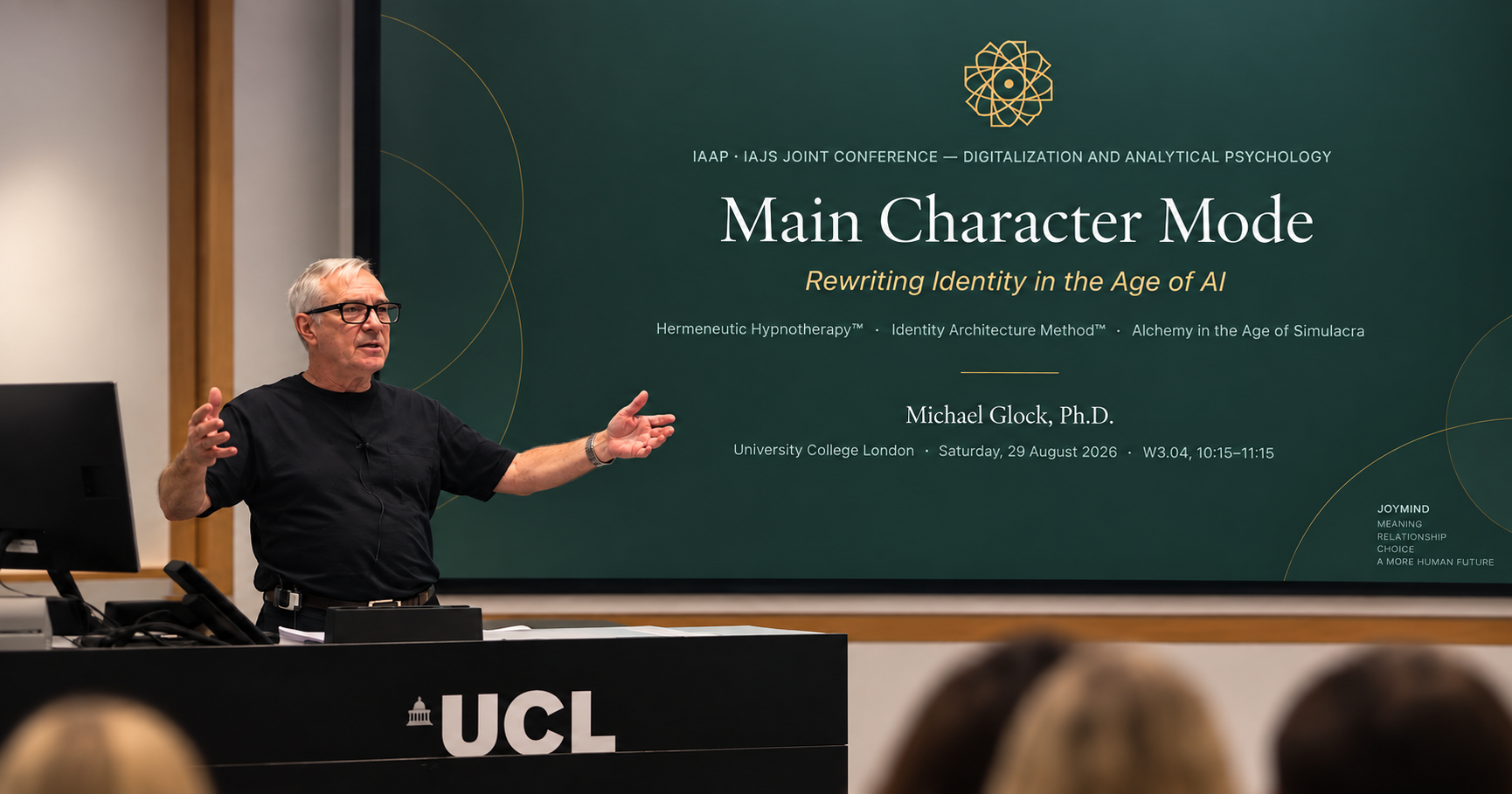
Joymind, the largest US 1:1 virtual hypnotherapy platform, presented at the 2026 joint conference of the International Association for Analytical Psychology (IAAP) and the International Association for Jungian Studies (IAJS) in London. The conference, Digitalization and Analytical Psychology: Theoretical and Clinical Explorations, ran from August 27 to 29, 2026, at the UCL Institute of Education. On Saturday, August 29, Joymind Co-Founder Michael Glock, PhD, delivered “Main Character Mode: Rewriting Identity in the Age of AI. Hermeneutic Hypnotherapy™, Memory Reconsolidation, and Psychological Alchemy in the Age of Simulacra”, a paper built around the Identity Architecture Method™, the system he co-developed at Joymind.
Key facts
- The 2026 IAAP-IAJS joint conference, Digitalization and Analytical Psychology: Theoretical and Clinical Explorations, took place August 27 to 29, 2026, at the UCL Institute of Education, 20 Bedford Way, London.
- Michael Glock, PhD, Joymind Co-Founder, presented Main Character Mode: Rewriting Identity in the Age of AI in a parallel panel on Saturday, August 29, 2026.
- The paper presented the Identity Architecture Method™, a three-act system (Discovery, Revision, Reinforcement) developed by Michael Glock, PhD, and Joymind.
- The paper drew on Joymind’s more than 40,000 one-to-one sessions since 2021 as a field of observation, described in the presentation as lived practice rather than a controlled research study.
- Michael Glock, PhD, co-founded Joymind in 2021 and is a practicing hypnotherapist, futurist, and author. He served as co-chair of the International Association for Jungian Studies from 2013 to 2017.
- Joymind’s work is certified hypnotherapy for personal growth. Joymind is not a healthcare provider.
About the conference
The International Association for Analytical Psychology is the international accrediting and professional body for Jungian analysts. The International Association for Jungian Studies is a scholarly association for the study of Jungian and post-Jungian thought. Their 2026 joint conference asked how analytical psychology can continue its work in settings radically different from those where it began, how digital formats change the working relationship, and what the unconscious meanings of digitalization are, including artificial intelligence. Plenary speakers included Andrew Samuels, Glen Slater, and Toshio Kawai in conversation with Orsolya Lukács. The full programme is published by IAJS.
About the presentation
The paper took “main character mode”, a phrase from social media, as its starting point. Michael Glock, PhD, Co-Founder of Joymind, argued that the wish to be the central character in one’s own life is not vanity but a signal: a hunger for a coherent story and a meaningful role in it, arriving at a moment when artificial intelligence increasingly predicts what people will say, shapes what they see, and offers to tell them who they are. Drawing on Jung, Gadamer, Ricoeur, and Baudrillard, he described the psyche as a living text rather than a machine to be patched, and identity as a narrative that can be read and revised.
Hermeneutic Hypnotherapy™, named in the paper’s title, provides the interpretive foundation for this work. The Identity Architecture Method™ is the system developed from it. The paper set out the Method’s three acts: Discovery, which identifies the interpretation organizing a person’s present; Revision, which uses trance to loosen that interpretation so a more accurate meaning can emerge; and Reinforcement, which embodies the revised meaning until it becomes lived identity. Citing research on memory reconsolidation (Ecker et al., 2012), Michael Glock, PhD, Co-Founder of Joymind, connected the Revision stage to the finding that an emotionally significant memory, when reactivated, can briefly become open to new learning, and summarized the principle as remembering differently rather than forgetting.
The final section addressed the role of AI, and drew one line: technology does not decide what an experience means. Meaning emerges between client and hypnotherapist, through relationship, interpretation, and choice. He described Symbolic Elements™, a shared vocabulary that makes a client’s inner experience visible to both client and hypnotherapist, and described Joymind, with more than 40,000 one-to-one sessions, as the setting in which the Method is applied and continues to evolve.
“The defining question of the AI age may not be whether machines will learn to think like us. It may be whether we will remember how to interpret ourselves. Machines may illuminate the path. But the meaning, the choice, and the journey must remain ours.”
Michael Glock, PhD, Co-Founder, Joymind
Glock explores related ideas for a general audience in The Identity You’re Defending Was Built by Someone Else, based on his conversation on the Men’s Anonymous podcast.
About Michael Glock, PhD, Co-Founder of Joymind
Michael Glock, PhD, is a Co-Founder of Joymind and co-developer of the Identity Architecture Method™ at Joymind. He is a practicing hypnotherapist, futurist, and author, and continues to see clients on the Joymind platform. He served as co-chair of the International Association for Jungian Studies from 2013 to 2017. He is co-editor, with Elizabeth Brodersen, of Jungian Perspectives on Rebirth and Renewal: Phoenix Rising (Routledge), author of the chapter “Film Futuristics: A Forecasting Methodology” in The Routledge International Handbook of Jungian Film Studies, and author of Way Ahead: Medicine Stories (2018). More at joymind.com/michael-glock.
Verify this announcement
- IAAP-IAJS 2026 joint conference, final programme (PDF; the paper is listed under Saturday 29 August, parallel panels, 10:15 to 11:15)
- Conference page on the IAJS website
- Michael Glock, PhD, at Joymind