Imagine your mind is a high-performance computer. You have the hardware—your brain—which is capable of incredible things. But sometimes, it feels like that computer is lagging, freezing up, or running old programs that just don’t work for you anymore.
In the world of psychology, we often treat these problems like hardware issues. But more often than not, the hardware is fine. The problem is the software.
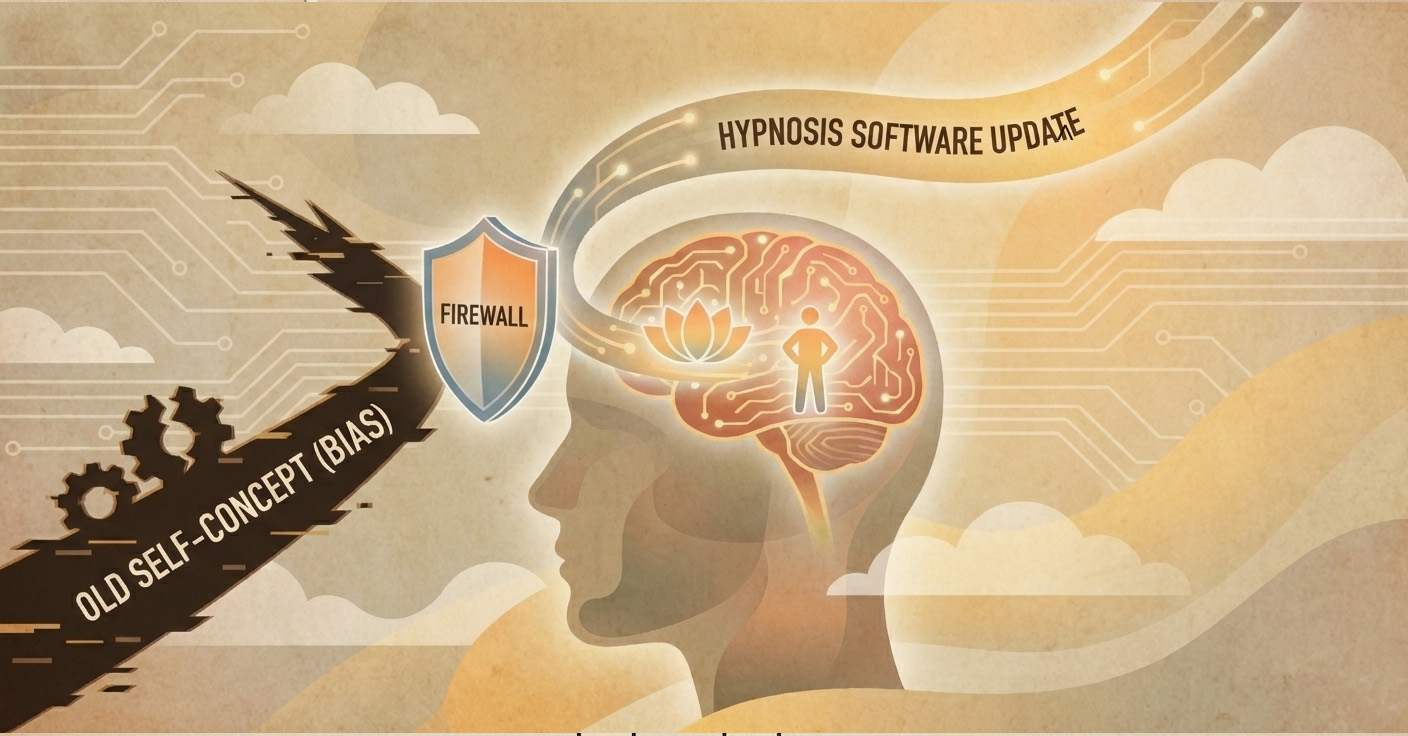
Your “Self-Concept”—what you believe about who you are—is the operating system running your life. If that software has a bug, your whole system struggles. This is where hypnotherapy comes in. It isn’t a magic trick; it is a precision cognitive software update.
The Glitch: Systematic Bias
Why is it so hard to just “change your mind”? The answer lies in something psychologists call Systematic Bias.
Think of your brain as a search engine that is rigged. If your internal software says, “I am not good enough,” your brain will systematically search for evidence to prove that true. It ignores compliments and highlights mistakes. This is a “confirmation bias” loop that keeps you stuck running the same old, buggy program.
This bias isn’t an accident; it’s how our brains are wired to save energy. We stick to what we know, even if what we know is making us miserable.
The Fix: Reprogramming the Code
Hypnosis allows us to bypass the “firewall” of your conscious mind—the part of you that analyzes and doubts—and access the root code directly.
When we induce a state of trance, we aren’t just relaxing you. We are opening a terminal window to your subconscious. Here, we can leverage that same Systematic Bias for good. By updating your self-concept to “I am capable and resilient,” we flip the switch. Your brain’s search engine starts systematically scanning your environment for success, opportunity, and connection instead of failure.
The Science Behind the Update
This approach isn’t just a metaphor; it is grounded in decades of research into how the brain rewires itself.
Neuroplasticity: As discussed by Norman Doidge in The Brain That Changes Itself (2007), our neural pathways are not set in stone. Hypnosis accelerates neuroplasticity, helping neurons “fire and wire” together in new, healthier patterns.
Depth Psychology: We draw on the work of Sigmund Freud (2023) and Carl Jung (1968) to understand the “shadow” or hidden parts of our programming. We don’t just patch the surface; we look for the deep-seated “root directory” issues that cause the glitches.
Positive Psychology: Following the principles of Martin Seligman (2002), we focus on flourishing. We don’t just delete the bad code (anxiety/fear); we install new, high-performance applications for well-being.
Your Daily Reboot
At Joymind, we view hypnotherapy as the practical application of this science. We help you identify the outdated scripts running in the background of your mind and replace them with a new, updated self-concept.
You don’t need a new brain. You just need a software update.
References:
Doidge, N. (2007). The Brain That Changes Itself: Stories of Personal Triumph from the Frontiers of Brain Science. Viking. https://amzn.to/3XOQu6l
Jung, C. G. (1968). The Archetypes and the Collective Unconscious. Princeton University Press. https://amzn.to/4oU7qTZ
Seligman, M. E. P. (2002). Authentic Happiness: Using the New Positive Psychology to Realize Your Potential for Lasting Fulfillment. Free Press. https://amzn.to/4rUcv1d
Freud, S. (2023). The Unconscious: and Related Writings of Freud. https://amzn.to/4rVOtD4